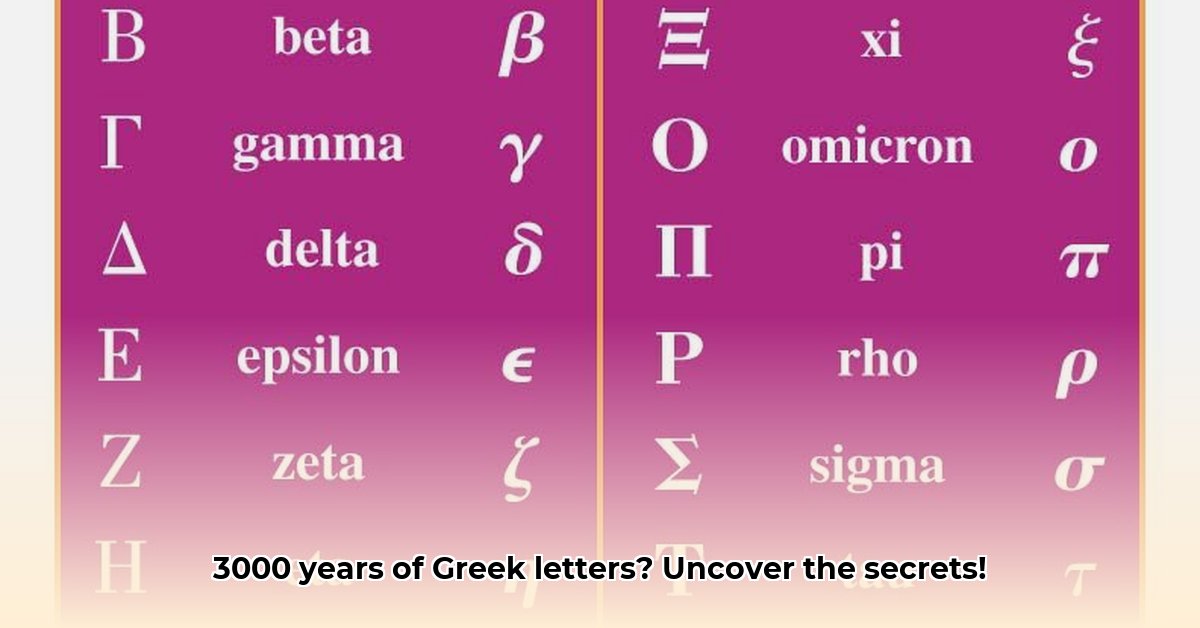
Griekse Letter: A Journey Through Time
Ag shame, hey? Ever stopped to think about the alphabet you use every day? Its story is longer than a lekker braai, and a big chunk of it starts with the ancient Griekse Letter. Picture this: ancient Greece, bustling with markets, philosophers arguing, and scribes carefully chiselling letters onto stone or using reeds on papyrus. These weren't just doodles; they were a communication revolution. The Griekse Letter, born from the Phoenician alphabet, had a killer feature: vowels! Sounds small, right? But it was HUGE. Try reading without vowels – impossible, ja? The Greeks' addition of vowels made writing clearer and more expressive. This innovation still has a massive impact today.
Did you know that the early days of the Griekse Letter weren't exactly uniform? It was like the Wild West of alphabets, with different bits of Greece using their own little versions. Think of the different accents and slang around South Africa – a bit similar, right? But eventually, things settled. By the 4th century BC, they'd mostly standardised it into the familiar 24-letter system we know now. This was a massive achievement, making communication much easier across Greece. Why did this happen? Maybe better record-keeping for trade or government, or just an easier way to share ideas. Historians are still busy figuring it out.
The Griekse Letter didn't stop there. Lowercase letters, for instance – those only appeared later, in the Byzantine era. That made a big difference, making writing easier. Can you imagine writing in all capitals all the time? Lowercase letters probably made writing faster and more comfortable, improving literacy. How cool is that?
The Griekse Letter's influence spread way beyond Greece, becoming the ancestor of many alphabets we use today. Latin, Cyrillic (used in Russia and Slavic languages), even Coptic (an ancient Egyptian alphabet) – they all have Griekse Letter DNA! How did that happen? Trade routes were a major factor: Merchants carried their writing systems across huge distances. Conquests played a part too; empires often spread their writing systems, and cultural exchange saw the adoption of Greek alongside others. Is that not amazing?
Even today, the Griekse Letter is still going strong. You might not realise it, but you see it daily. In maths and science, symbols like pi (π), delta (Δ), and sigma (Σ) all come from the Greek alphabet. It's not just words; it's part of our scientific and technological vocabulary. Don't you think that's impressive?
And the study of the Griekse Letter keeps going! Archaeologists and historians are always discovering new inscriptions, revealing more about the ancient Greek world. Every new find adds to the story, improving our understanding of their culture and lives. Epigraphy, the study of inscriptions, is a whole field dedicated to uncovering this knowledge.
How Did Regional Variations in Ancient Greek Script Influence Its Standardization?
Imagine a world without a standard alphabet. Different parts of Greece initially used different Greek alphabets – like different dialects of a language. This wasn't chaos, but an interesting process! Let's explore this journey.
The Greek alphabet didn't appear overnight. It came from the Phoenician alphabet, a script without vowels. Clever Greeks added vowels – a brilliant innovation. But adoption wasn't uniform. Different city-states and regions adapted the Phoenician script in their own way. This created a variety of local alphabets, each with its unique letter shapes and occasional variations in letter order. It's like having regional recipes for the same dish – same basic ingredients, but different spices and methods!
Early inscriptions on pottery, stone, and metal showed these diverse forms. Some regions kept their unique styles for centuries. The eventual standardization wasn't sudden. It was a gradual process influenced by practical needs and cultural factors. The rise of Athens as a major power led to the wider adoption of its alphabet variant. It wasn't just dominance; it was about convenience. The spread of Attic script (the Athenian variant) was helped by Athens' powerful navy, facilitating communication and trade. It was like a slow wave, gradually replacing local versions with the Athenian standard.
Despite a more consistent alphabet, some regional variations stayed around. These subtle differences in letterforms mirror the linguistic and cultural diversity of the Greek world. They are a tangible link to the past and show the richness of Greek culture. Isn't that fascinating?
The standardization of the Greek alphabet was a turning point in history. It laid the foundation for many alphabets we use today, including the Latin alphabet that underpins English. The process shows the dynamic relationship between language, culture, and technology. It proves how communication needs shape the tools we use to communicate. This evolution is something to truly celebrate!
Key Takeaways:
- The Greek alphabet's roots are in the Phoenician script, but the Greeks added vowels.
- Early Greek alphabets showed many regional differences in letterforms and order.
- Standardization wasn't sudden, but a gradual process influenced by trade, politics, and the need for clear communication.
- The spread of Attic script, thanks to Athens' power, played a key role in standardization.
- Regional variations remained, reflecting the diverse ancient Greek world.
- The standardization of the Greek alphabet had a major lasting impact, influencing the development of many modern writing systems.